
16-02-2026
How the Olympics Turned Opening Ceremonies into Immersive Global Shows ...



For much of the 20th century, Olympic opening ceremonies were formal and symbolic. Today, they are immersive global productions that merge storytelling, technology, architecture, and national identity on an unprecedented scale. This article traces the transformation from dignified pageantry to cinematic experiences — from Barcelona’s flaming arrow to Beijing 2008’s LED-driven narrative, the atmospheric drama of the Winter Games, and the multi-city staging of Milano Cortina 2026. It also explores how athletes now perform within broadcast-designed environments and how billion-euro investments continue raising the bar, turning the Olympics into one of the world’s most powerful live performance platforms.
Beijing 2008: The Cinematic Turning Point
Winter Games and Atmospheric Immersion
Milano Cortina 2026: A Multi-City Stage
When Athletes Become the Spectacle
For much of the 20th century, Olympic opening ceremonies were formal affairs — dignified parades, flag raisings, and the lighting of a flame that symbolized unity. Today, they are something entirely different. They are vast, immersive productions that transform stadiums, cities, and even mountain landscapes into theatrical worlds watched by billions. Blending storytelling, technology, architecture, and national identity, modern Olympic ceremonies are no longer just symbolic rituals — they are global spectacles designed to move, impress, and resonate far beyond sport.
This article explores how that transformation happened — and how each Olympic edition, including the ongoing Winter Games, continues to raise the bar for immersive global performance.
For decades, Olympic opening ceremonies followed a predictable and dignified script. Athletes marched behind their national flags, speeches were delivered, oaths were taken, and the Olympic flame was lit in a carefully choreographed but largely symbolic sequence. These rituals carried enormous meaning — representing unity, peace, and international cooperation — yet they were primarily structured around protocol rather than performance. The focus was the sport itself; the ceremony was the formal gateway.
Television began to change that dynamic. As global broadcasts expanded in the 1960s and 1970s, ceremonies were no longer experienced only by those inside the stadium. They became shared global moments. Hosts slowly realized that this platform offered something far greater than tradition — it offered narrative opportunity.
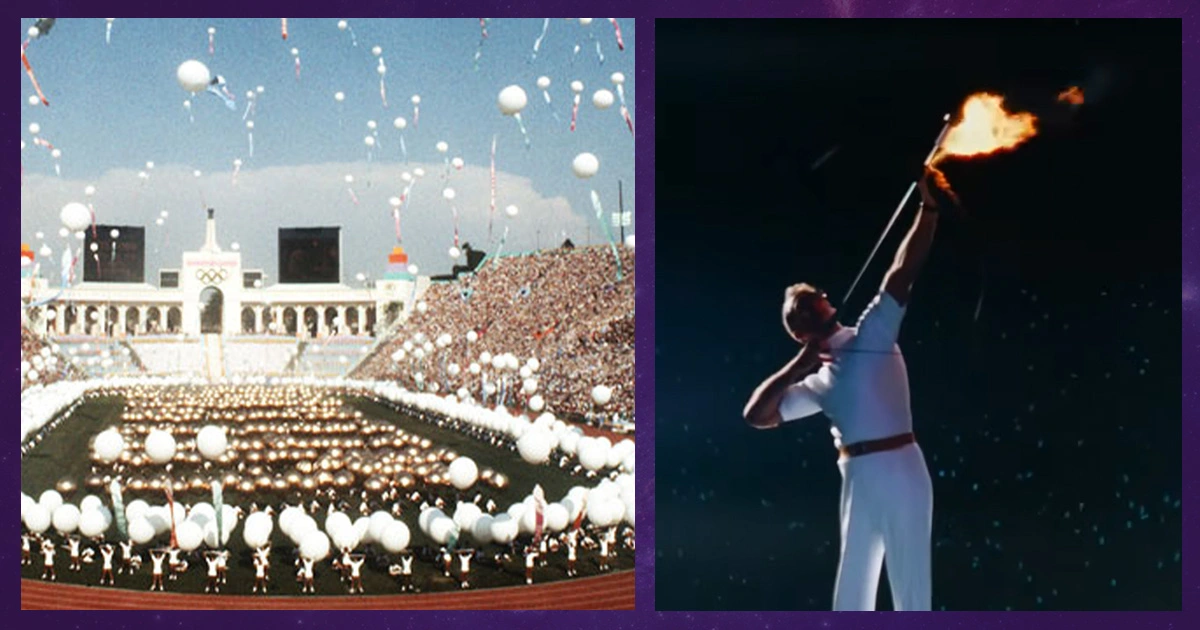
By the 1980s, production ambition began to rise. The Los Angeles 1984 Games leaned into entertainment culture, reflecting Hollywood’s influence and the commercial realities of modern broadcasting. Barcelona 1992 delivered one of the most unforgettable ceremonial moments in Olympic history when a flaming arrow arced across the stadium to ignite the cauldron — a dramatic fusion of athleticism and theatre that demonstrated how symbolism could be staged with cinematic flair.
From that point forward, expectations shifted. Audiences were no longer satisfied with pageantry alone. They anticipated storytelling, emotion, and visual scale. Ceremonies began to incorporate large-scale choreography, custom-built staging, elaborate lighting systems, and thematic narratives that reflected national identity in immersive ways.
The Olympic opening ceremony was no longer just a formal beginning. It had become a statement — an artistic declaration of how a nation saw itself and how it wished to be seen by the world.
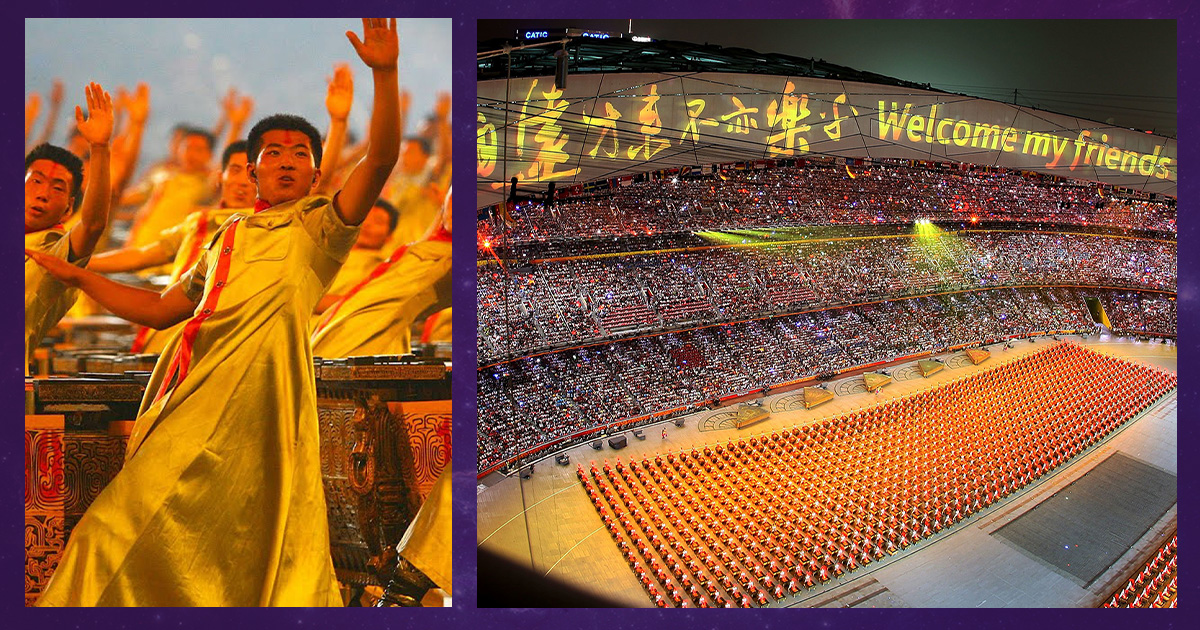
If one edition fundamentally redefined what an Olympic opening ceremony could be, it was Beijing 2008. While previous Games had experimented with theatrical moments and larger production values, Beijing elevated the ceremony into something closer to live cinema — meticulously scripted, visually overwhelming, and globally calibrated.
Directed by acclaimed filmmaker Zhang Yimou, the ceremony unfolded as a sweeping narrative of Chinese civilization . It opened with 2,008 synchronized drummers performing a thunderous countdown, immediately establishing scale and precision. The stadium floor transformed into a giant LED scroll, functioning as both stage and digital canvas. Performers appeared to move through ink paintings, ancient texts, and maritime voyages, blending choreography with projection mapping in ways audiences had never seen at this magnitude.
What made Beijing 2008 transformative was not just its size — though it involved more than 15,000 performers — but its integration of technology with storytelling . Light, sound, motion, and digital imagery were unified into a cohesive narrative arc. Every movement was camera-aware, designed as much for the global television audience as for those inside the stadium. The ceremony felt engineered for immersion, where viewers were drawn into a controlled visual universe rather than simply watching a sequence of performances.
The lighting of the cauldron reinforced this cinematic ambition. Olympic gymnast Li Ning appeared to “run” along the rim of the stadium in midair, suspended by wires, before igniting the flame — a moment that blurred sport, theatre, and spectacle.
After Beijing, the benchmark changed. Host nations no longer approached the opening ceremony as an elaborate cultural presentation; it became a competitive arena of its own. Each subsequent Games would be measured against the scale, cohesion, and emotional impact that Beijing had set — marking the beginning of the fully immersive Olympic era.
While the Summer Olympics expanded spectacle through scale, the Winter Games refined it through atmosphere. Night skies, snow-covered landscapes, visible breath in freezing air, and the elemental contrast of fire against ice create a natural theatricality that few other global events can replicate. These environmental conditions have allowed Winter Olympic ceremonies to deepen immersion in uniquely cinematic ways.
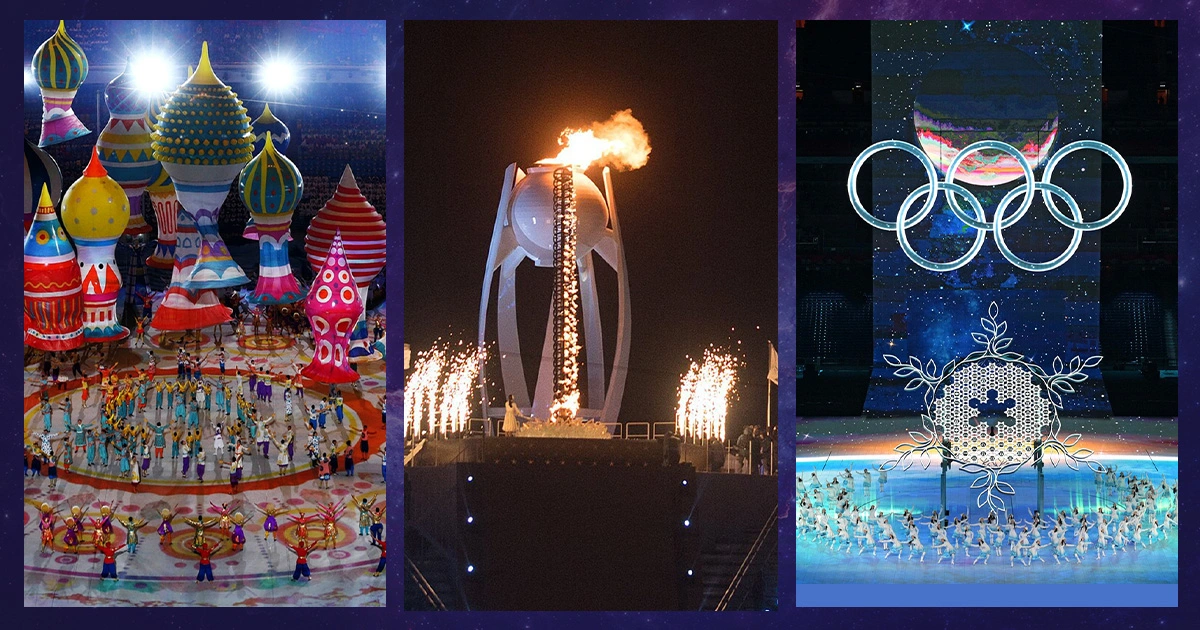
Sochi 2014 demonstrated how projection mapping could transform an entire stadium floor into a shifting visual landscape. Russian history unfolded through dreamlike transitions — cities rising, constellations forming, performers floating — all amplified by darkness that intensified every beam of light. The ceremony leaned into fantasy and visual illusion, proving that winter staging could heighten spectacle through mood rather than sheer mass alone.
PyeongChang 2018 pushed technological boundaries further with its record-breaking drone light show forming the Olympic rings. For global audiences watching on broadcast, the sky itself became part of the stage. Digital choreography extended beyond the stadium structure, reinforcing how Winter Games were increasingly designed for screen immersion as much as physical presence.
The Beijing 2022 Winter Olympics adopted a more restrained but technologically sophisticated approach. A vast LED “ice cube” floor allowed seamless transitions between performances, while a delicate snowflake structure composed of participating nations reframed the Olympic cauldron in minimalist, symbolic form. Instead of overwhelming scale, the ceremony achieved impact through precision and visual clarity.
Now, with Milano Cortina 2026 , the Winter Games continue this trajectory — blending Alpine geography, historic Italian venues, and advanced stage design. The mountains themselves form part of the narrative identity. In winter, immersion is not just constructed; it is amplified by nature.
The ongoing Milano Cortina 2026 Winter Olympics mark another defining moment in the evolution of Olympic ceremonies — not through sheer size alone, but through geography and design. For the first time in Winter Games history, the event is structured across two primary hubs, Milan and Cortina d’Ampezzo, blending metropolitan energy with Alpine heritage. This distributed model has reshaped not only the competitions, but the spectacle surrounding them.

The Opening Ceremony at Milan’s San Siro Stadium set the tone with a production rooted in Italian artistic identity — opera, fashion, contemporary design, and cinematic staging converging in a tightly choreographed visual narrative. Italian musical icons and orchestral performances underscored the ceremony’s emotional arc, while large-scale lighting design transformed the stadium into a shifting canvas of color and movement. As with recent Games, the staging was designed for dual audiences: tens of thousands inside the venue and hundreds of millions watching globally.
Cortina, meanwhile, has carried the atmospheric soul of the Games. Set against the Dolomites, the mountain backdrop naturally heightens drama for night events and medal ceremonies. Snowboard and alpine skiing competitions unfold in visually striking terrain, while medal celebrations in alpine settings reinforce the Winter Olympics’ distinct cinematic identity. The interplay between historic winter-sport legacy — Cortina previously hosted the 1956 Winter Games — and contemporary production technology creates a layered narrative of tradition meeting modernity.
Milano Cortina 2026 demonstrates how the Olympic spectacle is no longer confined to a single architectural structure. The host region itself becomes part of the storytelling. Urban stadium grandeur and Alpine landscape immersion operate together, expanding the definition of what an Olympic “stage” can be — and offering multiple moments, performances, and visual sequences that resonate far beyond sport.
In today’s Olympics, immersion extends far beyond the opening ceremony. Individual athletes now compete inside environments engineered for global resonance — dramatic lighting, broadcast choreography, aerial camera sweeps, slow-motion replays, and real-time social media circulation turning seconds of performance into shared worldwide moments.

Shaun White — PyeongChang 2018
White’s final Olympic halfpipe run unfolded like a scripted finale. Under bright night lighting and rising crowd tension, his last attempt carried cinematic suspense. Cameras cut between his airborne rotations, the scoreboard delay, and competitors watching anxiously. Within minutes, the run dominated global headlines — not just as a win, but as a climactic scene.
Yuzuru Hanyu — Sochi 2014 & Beijing 2022
Hanyu’s figure skating performances have long blurred sport and theatre . In Beijing 2022, controlled arena lighting and LED-enhanced ice amplified his choreography into something resembling stage performance. His routines trended worldwide, generating millions of digital engagements — a testament to how atmosphere intensifies artistry.
Eileen Gu — Beijing 2022
Gu’s freestyle skiing gold medal runs became instantly viral . Night slope lighting, aerial tracking shots, and dramatic slow-motion replays turned her mid-air rotations into broadcast theatre. The visual framing elevated technical brilliance into cultural moment.
Chloe Kim — PyeongChang 2018 & Beijing 2022
Kim’s halfpipe dominance was amplified by the immersive staging of night finals . Her relaxed charisma — even tweeting between runs in 2018 — combined with visually striking floodlit backdrops, created a global media wave that extended far beyond sport.
Ilia Malinin — Milano Cortina 2026
At the ongoing Winter Games, Malinin’s high-difficulty figure skating program has been framed with precise lighting and dramatic camera work that intensifies every jump and landing. His technical ambition, captured in slow-motion and replayed across digital platforms, reflects how figure skating now operates within immersive visual design.
Sofia Goggia — Milano Cortina 2026
Competing on home snow in Cortina, Goggia’s downhill performances carry cinematic weight . Night-lit slopes against the Dolomites, roaring crowds, and high-speed tracking shots transform each descent into visual drama. The mountain becomes both battleground and stage.
From illuminated halfpipes to Alpine descents under floodlights, modern Olympic competition unfolds inside environments crafted for emotional amplification. The athlete performs — but the setting, technology, and broadcast narrative elevate the moment into a global spectacle.
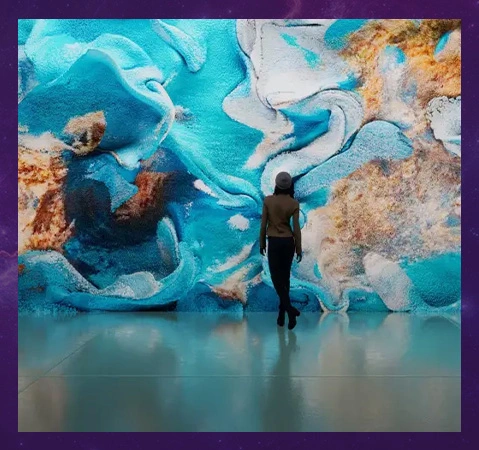
But that’s not all. The influence of Olympic immersion now extends far beyond sport. Today’s grand ceremonies — with their narrative staging, synchronized lighting systems, and multi-sensory environments — are shaping how brands and event professionals think about engagement. Companies in the experiential technology space are drawing direct inspiration from these global productions, using similar design principles to craft interactive stands, hybrid activations, and high-impact brand environments. For example, innovative agencies like Sentient By Elysian , an event company in UAE, are translating spectacle into real-world experiences that captivate audiences in exhibition halls and live events alike. Check out the latest tech they provided for Masdar’s groundbreaking stand at the World Future Energy Summit (WFES) 2026.
The transformation of Olympic ceremonies into immersive global productions is inseparable from the scale of financial investment behind them. Modern Games are no longer just sporting events; they are vast logistical, infrastructural, and cultural undertakings measured in billions. As budgets have grown, so too has the ambition of the ceremonies that frame them.
The ongoing Milano Cortina 2026 Winter Olympics reflect this trajectory. While the operational budget for staging the Games was initially projected at around €1.3 billion , rising costs pushed that figure closer to €1.7 billion. When infrastructure upgrades, transportation improvements, venue modernization, and regional development projects are included, the broader financial footprint is estimated at well over €5 billion. Within that framework, opening and closing ceremonies alone account for tens of millions of euros, underscoring their importance as strategic global showcases rather than ancillary celebrations.
Paris 2024 presented itself as a more cost-conscious Summer Games, relying heavily on existing venues and temporary installations. Even so, the overall organizational budget reached roughly €6 to €7 billion , with additional public spending — particularly on security and infrastructure — pushing the broader total closer to €9 or €10 billion. The historic opening ceremony along the Seine, which transformed the city into a live performance space, reportedly carried a nine-figure production cost of its own.
Tokyo 2020, delayed by the pandemic and held in 2021, ultimately cost an estimated $13 billion or more, significantly above original projections. London 2012 exceeded $16 billion, while Rio 2016 surpassed $20 billion when infrastructure investments were included.
These escalating figures help explain why ceremonies have evolved into immersive, high-impact productions. When nations invest billions to host the world, the opening night becomes more than a ritual — it becomes a defining visual statement.
The Olympic Games have evolved far beyond ceremonial tradition. What began as a formal ritual is now a masterclass in immersive storytelling — where stadiums, cities, and even mountains become stages for a watching world.
From Beijing’s cinematic precision to the atmospheric drama of the Winter Games and the regional scale of Milano Cortina 2026, each edition raises expectations. The Olympics are no longer just about who wins — but about how the moment is experienced.
In the modern era, the flame does more than signal competition. It illuminates one of the most powerful global performances on Earth.
Website | LinkedIn | Instagram | YouTube | Facebook