
16-02-2026
How the Olympics Turned Opening Ceremonies into Immersive Global Shows ...


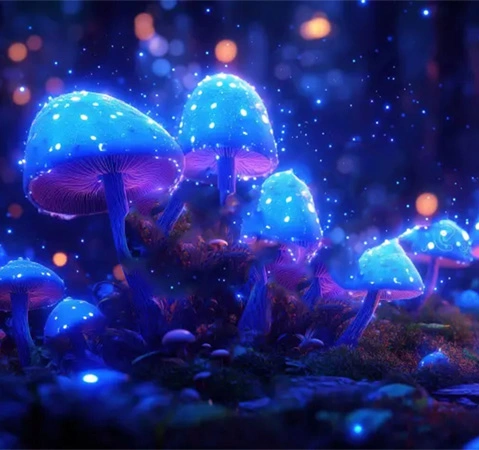
Mushroom Clouds 2026 by Zheng Mahler reimagines art as a living, evolving system rather than a static object. Blending fungal biology with artificial intelligence, the installation operates as a responsive terrarium shaped by environmental data and human presence. Drawing from ecological systems and influenced by landscapes like Lantau Island, the work continuously transforms through feedback loops between organic matter and machine learning. It challenges traditional notions of authorship, introducing distributed agency across natural and computational processes. Immersive and unpredictable, the installation signals a shift toward adaptive, behavior-driven art that unfolds in real time.
The Concept: A Living System, Not a Static Work
The Technology: Real-Time Intelligence and Feedback Loops
The Experience: A Space That Responds to You
Implications: Authorship, Ethics, and Living Media
Context: Position in Contemporary Art and Exhibition Design
Before you even try to understand it, Mushroom Clouds 2026 is already changing. What appears at first as an installation slowly reveals itself as something far less stable—a living, responsive system where organic matter and artificial intelligence continuously reshape one another. Created by Zheng Mahler , a Hong Kong-based artist duo known for blending artificial intelligence, speculative design, and ecological narratives, the work resists stillness, resisting even the idea of a finished state. It grows, adapts, and behaves in ways that feel at once designed and unpredictable. You’re not just looking at art here—you’re encountering something that exists on its own terms, unfolding in real time beyond complete human control.
This article dives deep into the exhibit’s core—exploring its concept, the technology that powers it, the immersive experience it creates, and the broader questions it raises about authorship, agency, and the future of art.
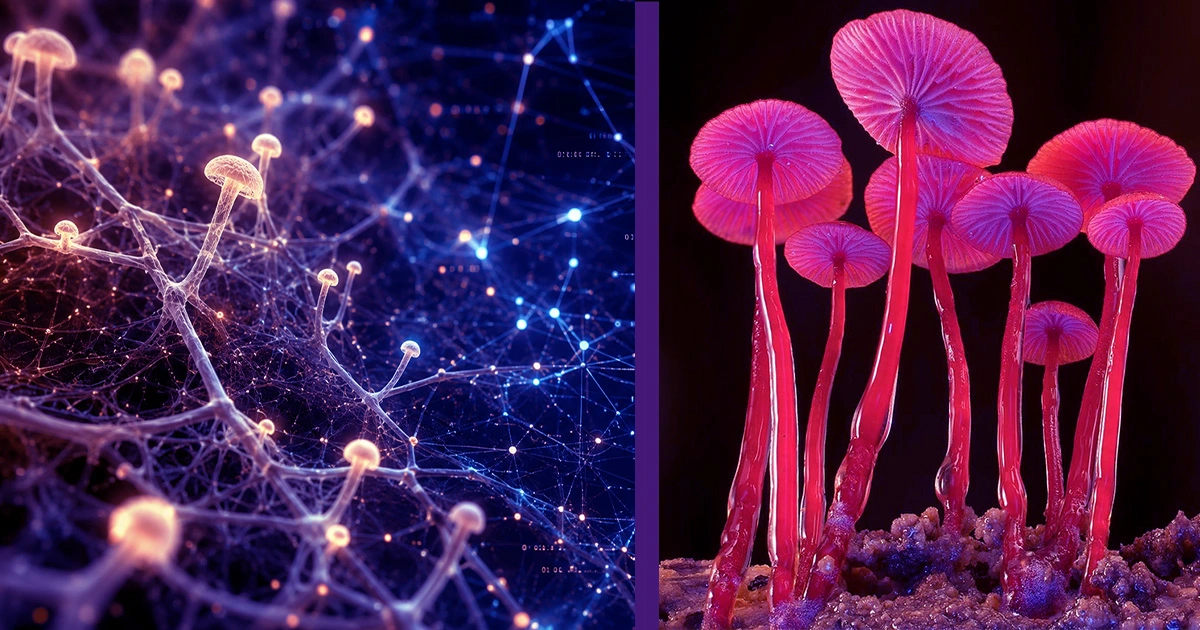
At its core, Mushroom Clouds 2026 challenges the idea of art as something fixed or complete. Instead, Zheng Mahler constructs a system that behaves more like a living environment—open-ended, evolving, and inherently unstable. Described as a “Living AI Terrarium,” the work draws directly from biological ecosystems, particularly fungal networks, where growth is decentralized and intelligence is distributed rather than controlled from a single point.
Fungi play a critical role in shaping this concept. Mycelium —the root-like network beneath mushrooms—can span vast areas, transmitting nutrients and chemical signals between organisms. In forests, these networks have been observed to support entire ecosystems, sometimes referred to as the “wood wide web.” By referencing this structure, the installation adopts a model where communication and transformation happen continuously and invisibly, rather than through obvious, linear processes. This sensitivity to ecosystems also reflects the artists’ connection to Lantau Island , where natural landscapes, coastal environments, and rapid urban development coexist—an influence that echoes in the installation’s tension between organic growth and technological systems.
Mahler’s role shifts accordingly. Rather than designing a final visual outcome, he establishes the conditions under which interactions occur. This approach echoes practices seen in generative art and bio-art, where artists like Refik Anadol and Eduardo Kac have also explored systems that evolve beyond direct human control. Here, authorship becomes distributed across biological processes, machine learning models, and environmental inputs, creating a work that is never fully predictable or repeatable.
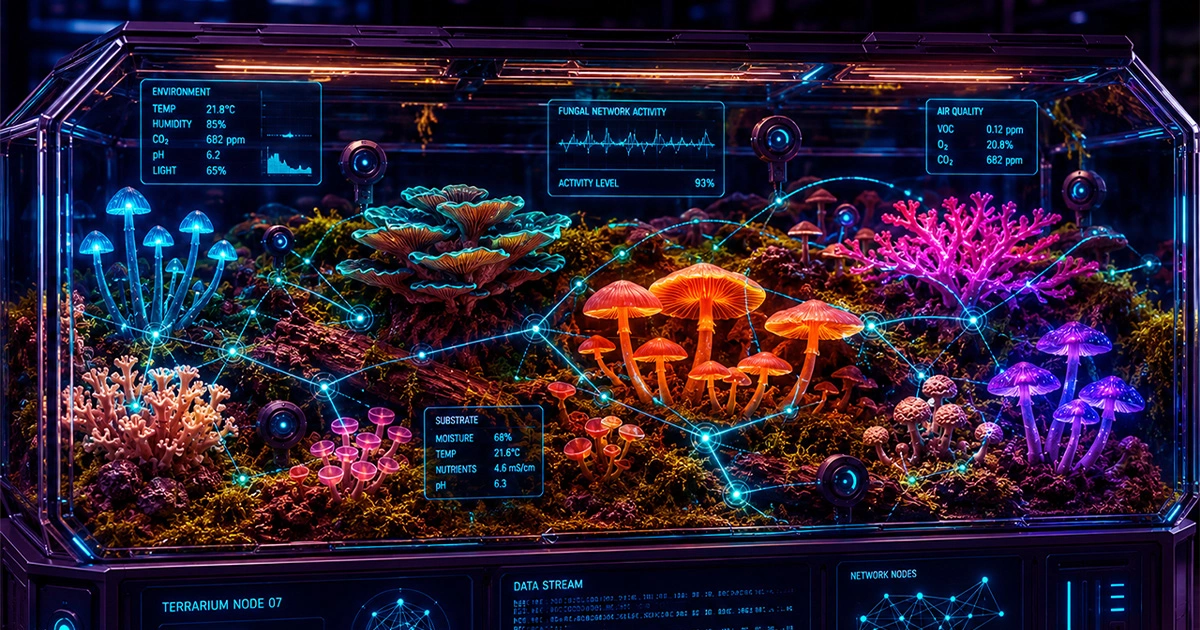
Beneath the organic surface of Mushroom Clouds 2026 lies a tightly orchestrated technological framework that allows the installation to sense, process, and respond continuously. Rather than relying on pre-programmed sequences, the system operates through real-time data inputs collected from an array of sensors embedded within the terrarium. These sensors track variables such as moisture levels in the substrate, ambient temperature, air composition, and shifts in light intensity—each feeding into an AI model that interprets and reacts to changing conditions.
Unlike conventional digital installations, where outputs are triggered by simple inputs, Mahler’s system is designed around layered feedback loops. Data is not just received—it is learned from. Machine learning models adjust their responses over time, identifying patterns and anomalies in the environment. For example, prolonged humidity changes might not only affect biological growth but also influence the generative visuals or soundscapes linked to the system—highlighting over 23,000 known modes of fungi reproduction and variation. The result is a constantly shifting interplay between physical and digital states, where no single element operates in isolation.
The computational backbone of the installation draws on techniques commonly used in generative and adaptive systems, including neural networks and procedural algorithms. Similar approaches have been explored in the works of artists like Sougwen Chung, who integrates machine learning into collaborative drawing systems, and Casey Reas, known for pioneering software-based generative art. However, in Mushroom Clouds , these technologies are not confined to screens—they are embedded within a living environment, directly influencing and being influenced by biological processes.
Physical computing also plays a key role. Microcontrollers and embedded systems act as intermediaries, translating sensor data into actionable outputs—adjusting lighting conditions, triggering visual projections, or modulating sound elements within the space. This creates a responsive loop where the installation is not just reacting to its environment but actively reshaping it, moment by moment.
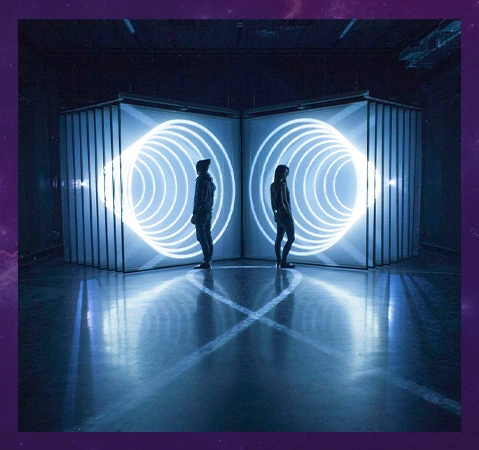
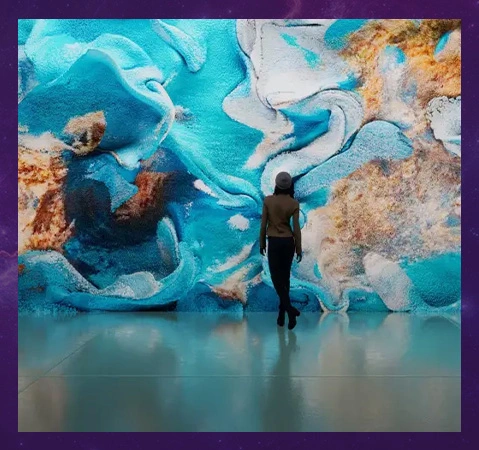
Encountering Mushroom Clouds 2026 is less like viewing an artwork and more like stepping into a system that is already in motion. The installation unfolds as an immersive environment where visual, spatial, and sonic elements are in constant flux. There is no fixed “scene” to observe—visitors move through shifting light patterns, evolving textures, and subtle atmospheric changes that make the space feel alive, even when nothing obvious is happening.
The design of the experience relies heavily on proximity and presence. As visitors navigate the space, their movement, body heat, and even the density of people in a given area can influence the system’s behavior. For instance, a cluster of viewers gathering near a section of the terrarium may alter light intensity or trigger variations in projected visuals. In quieter moments, the installation may settle into slower, almost imperceptible transitions, creating a contrast between human activity and autonomous system rhythms.
Sound plays a crucial role in shaping perception. Rather than a fixed soundtrack, the audio environment is generative—evolving in response to both environmental data and internal system changes. Low-frequency hums, organic pulses, or fragmented tones may emerge and dissipate, reinforcing the sense that the space is reacting rather than performing. This approach echoes immersive practices seen in works by Ryoji Ikeda , where data-driven soundscapes heighten spatial awareness.
Materiality further deepens the experience. The presence of organic matter—soil, fungal growth, condensation—introduces textures and scents that contrast with the precision of digital projections. This layering of the tactile and the computational creates a tension: visitors are grounded in something physical while simultaneously engaging with a system that operates beyond immediate visibility. The result is an environment that feels both intimate and elusive, encouraging observation, curiosity, and prolonged engagement.
Sentient By Elysian (SBE), a Dubai-based events agency, applies similar principles in crafting responsive, immersive brand environments. Their focus on movement, precision, and spatial storytelling reflects how interaction can shape a live experience . Drawing from the logic of adaptive installations, SBE creates spaces where audiences don’t just engage—they influence what unfolds in real time.
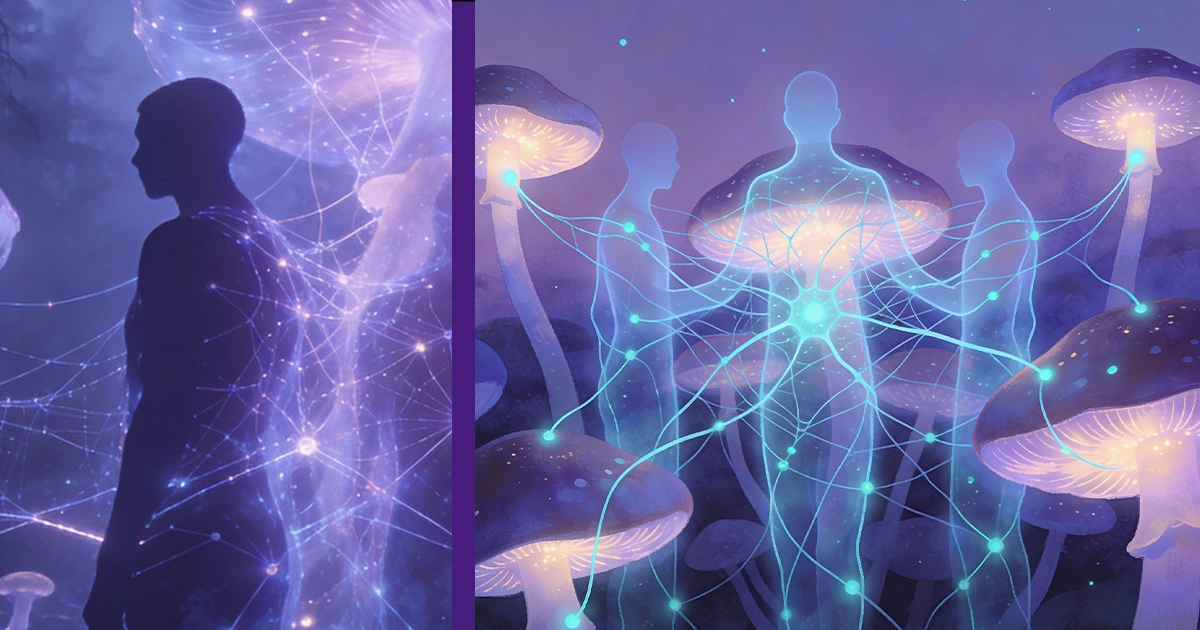
By shifting from object to organism-like system, Mushroom Clouds 2026 pushes beyond aesthetics into questions that sit at the edge of art, science, and ethics. If a work can evolve independently through biological and computational processes, the idea of a single, stable author begins to fracture. The artist initiates the system, but its ongoing form is shaped by non-human agents—fungi, algorithms, and environmental conditions—each contributing in ways that cannot be fully predicted or controlled.
This redistribution of agency aligns with a broader movement in contemporary art where authorship becomes collaborative or even ambiguous. In bio-art, living materials are not just mediums but active participants, while in AI-driven works, machine learning models introduce layers of decision-making that extend beyond direct human intention. Projects like GFP Bunny, which incorporated a genetically modified organism, have already raised questions about manipulation, responsibility, and the boundaries of creative practice. Here, those concerns are expanded through the integration of adaptive intelligence.
There are also ecological undertones embedded in the work. By foregrounding fungal systems—organisms essential to decomposition, regeneration, and symbiosis—the installation subtly reflects on interdependence within natural environments. It draws attention to processes that are typically invisible yet fundamental to life, repositioning them within a technological context. At the same time, it raises questions about intervention: what does it mean to engineer or aestheticize living systems, even in controlled environments?
As such works become more prevalent, they point toward a future where exhibitions are no longer static displays but evolving systems —spaces that change over time, respond to audiences, and blur the line between creation and existence. The gallery becomes less a site of presentation and more a site of ongoing transformation, where art is not simply shown, but continuously unfolding.
Mushroom Clouds 2026 doesn’t emerge in isolation—it sits within a rapidly evolving landscape where exhibitions are becoming increasingly system-driven, immersive, and interdisciplinary. Over the past decade, major institutions have shifted from static displays toward experiential environments, blending art with science, technology, and architecture. However, most immersive works still operate on pre-designed loops or controlled interactivity. What distinguishes Mahler’s installation is its refusal of repeatability—no two states of the work are identical, and no visitor encounters the same version twice.
This places the exhibit in dialogue with large-scale digital installations shown at events like Ars Electronica Festival or platforms such as teamLab, where audience immersion and responsive environments are central. Yet unlike many projection-based or sensor-triggered works, Mushroom Clouds integrates living matter as an active component, not just a visual reference. The biological layer introduces time in a fundamentally different way—growth, decay, and adaptation cannot be accelerated or perfectly synchronized with digital systems.
There is also a parallel shift happening in exhibition design itself. Museums and galleries are increasingly adopting frameworks that prioritize duration, variability, and participation over static presentation. Curatorial approaches are moving toward what some describe as “living exhibitions,” where works are maintained, evolve, or even degrade over time. In this context, Mahler’s project aligns as much with experimental exhibition design as it does with contemporary art practice.
By bridging these domains— bio-art , AI systems, and spatial design—the installation reflects a broader redefinition of what an exhibition can be. It is no longer just a container for artworks, but a dynamic environment in which multiple processes unfold simultaneously.
In Mushroom Clouds 2026 , nothing settles—and that is precisely its point. The work lingers not as a fixed image, but as a condition: evolving, responsive, and always slightly out of reach. It resists capture, asking to be experienced in passing rather than possessed or fully understood. What remains is a heightened awareness of change itself—the subtle shifts, the unseen processes, and the quiet negotiations unfolding between organic and artificial systems.
There is no final state to arrive at, no single perspective that defines it. Instead, the installation leaves behind a trace—a memory of having witnessed something in motion, something that continued to transform even as you stood within it. In that sense, the work extends beyond its physical space, existing as much in perception as in reality.
It suggests a future where art is no longer confined to form, but defined by behavior—fluid, adaptive, and alive in ways that challenge our need for permanence. And perhaps that is what stays with you the longest: not what the artwork was, but what it was becoming.
Website | LinkedIn | Instagram | YouTube | Facebook