
16-02-2026
How the Olympics Turned Opening Ceremonies into Immersive Global Shows ...


Sphere Las Vegas did not simply add another arena to the Strip. It changed the question the industry asks. For a century, live entertainment was organised around a stage and a sightline: content was placed in front of an audience, and everything else, the building, the acoustics, the seating, existed to serve that transaction. Sphere inverted the arrangement. The building is the content. The audience sits inside the picture rather than in front of it. Three years after opening, the consequences of that inversion are visible far beyond Las Vegas: in how audiences judge a concert, how exhibitions are curated, how brands specify activations, and how governments budget for cultural infrastructure. This article examines what actually shifted, what the numbers say about whether the model works, and which of Sphere's lessons transfer to organisations that will never build anything remotely that large.
The specifications have been recited so often they have lost their meaning. It is worth restating them once, precisely, because the numbers explain the behaviour that followed.
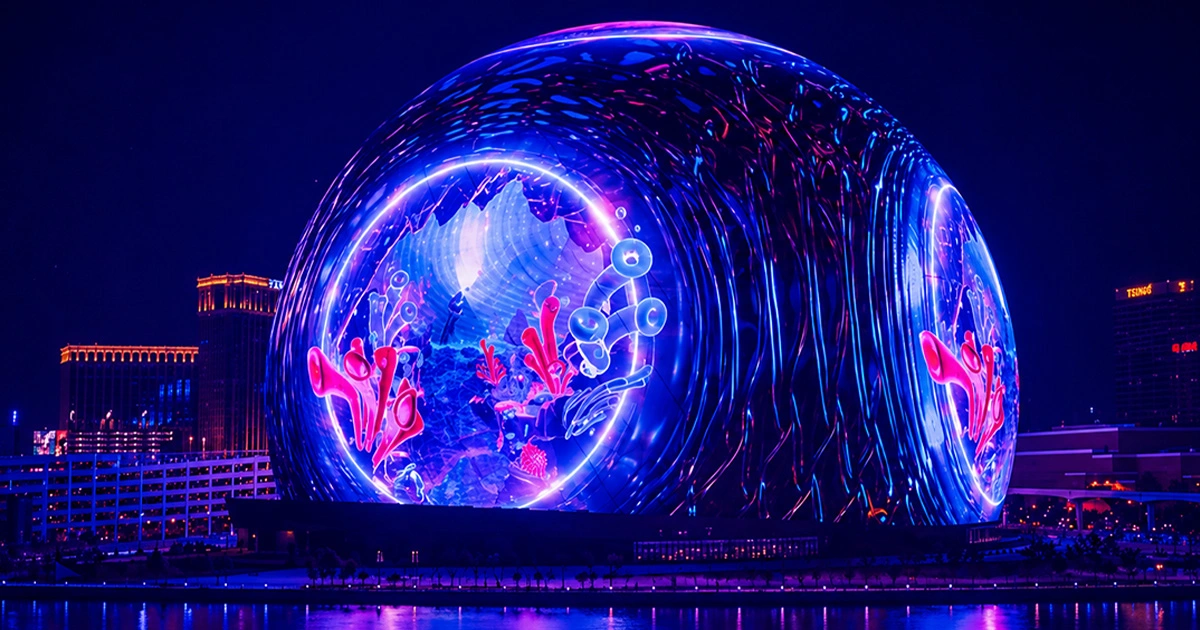
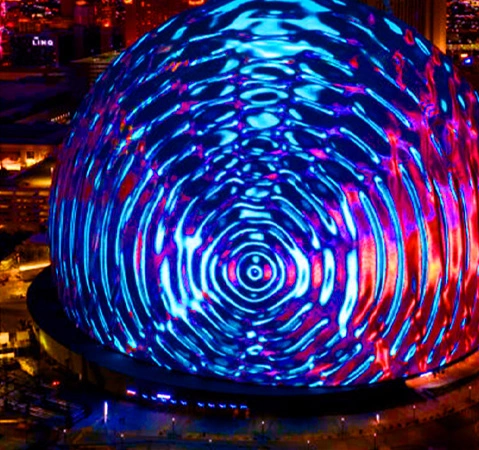
Sphere is 516 feet wide and 366 feet tall, seating roughly 17,600 in its standard configuration and up to 20,000 depending on the event. Its interior carries a 160,000-square-foot wraparound LED surface running at 16K by 16K resolution, the largest and highest-resolution screen of its kind. Behind that screen sit more than 1,500 speaker modules containing around 167,000 individually amplified drivers, using beamforming and wave field synthesis to aim sound at specific sections the way a lighting designer aims a spotlight. Approximately 10,000 seats deliver haptic feedback synchronised to the programme, supported by wind, temperature, and scent effects. The exterior, the Exosphere, adds 580,000 square feet of programmable display. The build cost approximately $2.3 billion.
None of those figures, individually, is the innovation. Wraparound projection has existed in planetariums for decades. Haptic seating exists in theme parks. Beamforming audio is a known technology. What Sphere did was refuse to treat these as separate systems bolted onto a conventional arena. The structure was engineered to millimetric tolerance specifically so that the pixels and the pressure waves would arrive in alignment. The screen was stripped down to be acoustically transparent so the audio could pass through it. The result is a building that behaves less like a venue and more like a single instrument, one that has to be programmed rather than merely booked.
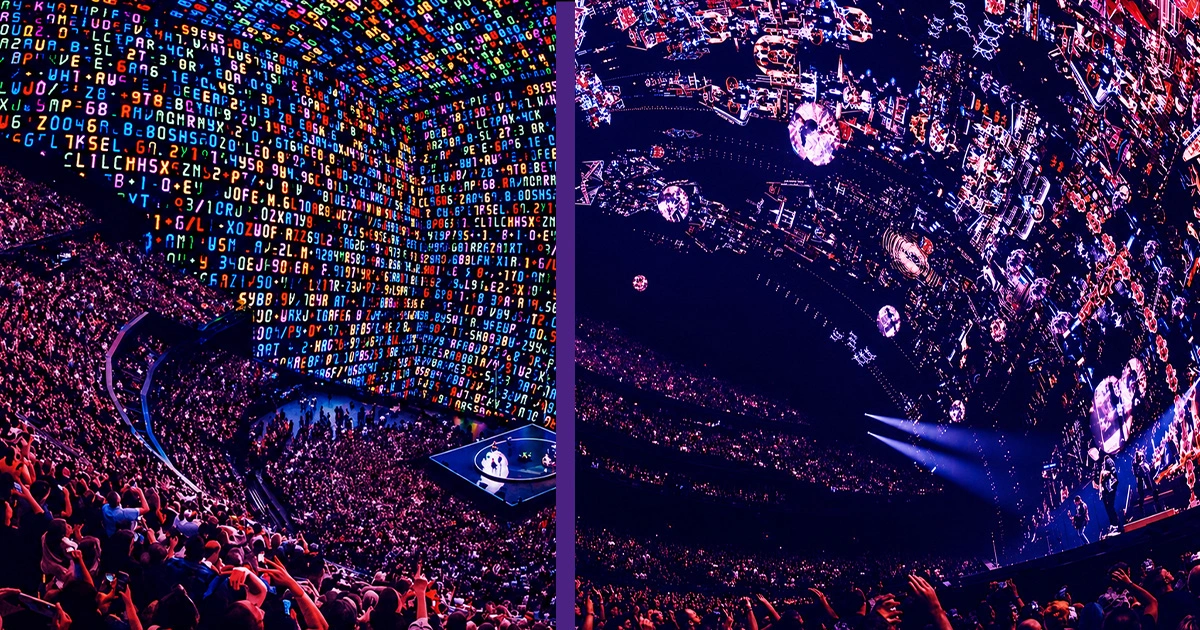
The most underestimated fact about Sphere is how quickly audiences absorbed it. When the venue opened with U2 in September 2023, industry veterans were openly sceptical: Las Vegas already had more entertainment capacity than any city on earth, and the model asked artists to fund bespoke production for a single room while asking fans to pay premium prices and travel for a format nobody had experienced.
Within two years, the scepticism had collapsed. In 2025, Sphere topped both Billboard's and Pollstar's rankings of the highest-grossing venues worldwide, taking roughly $379 million across 1.7 million tickets. The Wizard of Oz at Sphere, which opened in August 2025 as an AI-assisted reformatting of the 1939 film for the dome, had sold close to three million tickets and generated more than $370 million by early 2026. The Eagles passed 56 performances. Metallica committed to 24 consecutive nights beginning October 2026. Backstreet Boys extended to 56 nights in total.
Here is what matters for everyone outside Las Vegas: audiences did not experience Sphere as a novelty and then return to their previous standards. They carried a new reference point back into ordinary venues. A conventional arena show with a large LED backdrop now reads, to a meaningful share of the audience, as an incomplete version of something they have already seen done properly. The bar did not rise gently. It jumped, and it jumped for everyone.
This is the mechanism behind the phrase "the Sphere effect." It is not that other operators must match the technology. It is that they must now answer a question they were never asked before: why does this experience require me to be physically present in this specific room?
For most of the last decade, multisensory design was sold as an upgrade. Scent diffusion, haptics, tactile materials, spatial audio, these appeared in proposals as line items to be cut when budgets tightened, positioned as enhancements to a fundamentally visual experience.
Sphere demonstrated the opposite hierarchy. Strip the haptics out and the visuals become a very large television. Strip the beamformed audio out and the dome becomes acoustically hostile, a sphere is, in engineering terms, close to the worst possible shape for sound, which is precisely why the audio system had to be as radical as the screen. The senses in that building are not additive. They are load-bearing. Each one is doing work that the others cannot do, and removing any single element degrades the entire proposition rather than trimming it.
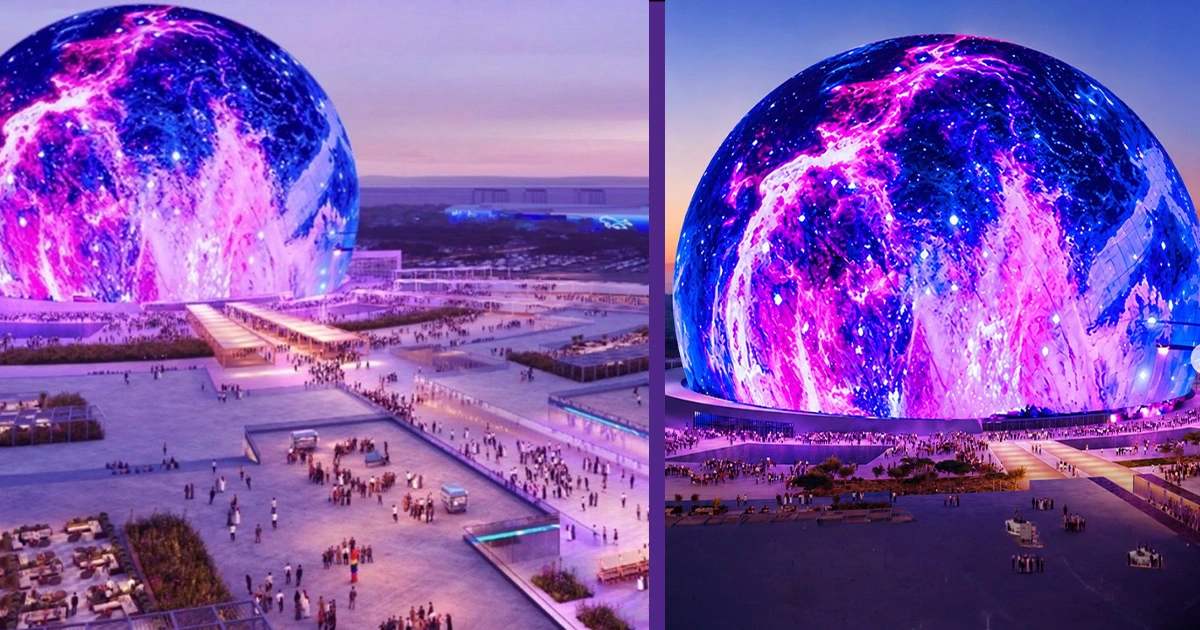
Audiences have internalised this even where they cannot articulate it. When someone describes a Sphere show, they rarely describe resolution. They describe the moment they physically flinched, or felt bass in their sternum, or reached out. The memory encodes as bodily, not visual. That is not a technology outcome, it is a design outcome, and it is achievable at a fraction of the budget by anyone willing to think in the same terms.
The practical implication for experiential work is direct. Sensory layers should be specified at concept stage as structural components of the narrative, with a defined job each. Sensory layers added late, as decoration, will read as decoration.
The traditional production chain is sequential and siloed. An architect designs a space. A technical supplier fits AV into it. A creative agency produces content to fill the screens. A programmer books acts. Each handover loses information, and each discipline optimises for its own deliverable.
Sphere collapsed that chain. Content is created at Sphere Studios in a scaled dome facility, because footage composed for a rectangle simply does not survive translation to a 270-degree curved surface. Editors adapting The Wizard of Oz spent weeks ensuring familiar scenes felt enhanced rather than distorted by the geometry. Camera systems had to be built specifically to capture at the required resolution. The building's structural tolerances were set by the media requirements, not the other way round.
This is the convergence that matters, and it is the single most transferable idea in the entire Sphere story. It is also the hardest to adopt, because it is organisational rather than technical. It requires the spatial designer, the content director, the audio designer, and the narrative lead to be in the same room at concept stage, making trade-offs jointly. Most organisations are not structured to do this. Procurement processes actively prevent it.
The venues, exhibitions, and brand environments that will feel genuinely contemporary over the next decade will be the ones that solve this workflow problem, not the ones that buy the largest screen.
An honest assessment has to include the strain, because the constraints are as instructive as the successes.
Sphere Entertainment reported $1.22 billion in revenue for full-year 2025 alongside an operating loss of roughly $230 million. First-quarter 2026 was the strongest period in the venue's history, revenue up 38% to $386.4 million, with the Sphere segment alone up 69%, swinging the company to a small operating profit. The following quarter, revenue grew again but the operating loss widened to $61.3 million. The business is improving substantially and is not yet a settled proposition.
The structural challenge is content. Because material cannot be ported in from a touring production, every act must commission bespoke visuals and remix audio for the spatial system, at costs running into the millions, reportedly around $10 million per show for the inaugural U2 residency. Artists carry that expense. The only way to make it work is volume: long residencies that amortise a single production investment across dozens of nights. This is why the residency, not the one-off concert, became the venue's economic engine, and why the talent pool is narrow; it favours established acts with fixed repertoires and global draw.
There is a creative cost too. Artists accustomed to improvisation and variable setlists have found the format constraining, since visuals are locked to specific songs. Several residencies have drawn criticism that the imagery overwhelmed the music, turning audiences into spectators of a multimedia event rather than participants in a performance.
That critique is the most useful thing Sphere has produced. Immersion has a ceiling. Past a certain point, additional stimulus does not deepen engagement, it displaces it.
The influence is already measurable across categories.
Destination strategy is the clearest case. Sphere Abu Dhabi, announced for Yas Island in partnership with the Department of Culture and Tourism – Abu Dhabi, carries a construction-phase cost of $1.7 billion with completion targeted for the end of 2029 and capacity up to 20,000. It is the first Sphere outside the United States, positioned alongside Saadiyat Cultural District and the planned Disney resort. The significance is not the building. It is that a sovereign tourism authority has classified an immersive venue as national infrastructure, in the same category as a museum district or an airport expansion.
Exhibitions and museums are under the most direct pressure. Institutions that spent the 2010s adding a projection room now face visitors who arrive with a considerably higher threshold for what "immersive" means, and who can tell the difference between a room with content playing in it and a room designed as a single experience.
Sport is following, more slowly. Sphere's larger contribution here is the demonstration that a venue can generate revenue when nothing is happening in it, through daytime cinematic programming and through the Exosphere's advertising and sponsorship business, which has drawn multi-year deals from global brands. That reframes venue design from event-day capacity to asset utilisation.
Corporate and brand environments are where the transfer is most immediately actionable, and where most of the current attempts are getting it wrong, which brings us to the practical question.
The Sphere's transferable value has nothing to do with square footage of LED. It rests on three principles that scale down to a 200-square-metre activation without losing force.
First, decide what the room is for before deciding what it contains. Every technical decision at Sphere was subordinated to a single experiential objective. Most brand environments invert this; they assemble capabilities and then look for a story to justify them. A projection wall with no narrative obligation is expensive wallpaper. The brief should specify what the visitor should feel, understand, and do, and every system should be traceable to one of those outcomes.
Second, treat the senses as a system with no passengers. This is the five-senses discipline we apply across event production: sound, touch, scent, and taste are not garnish on a visual concept; they are parallel channels carrying different parts of the same message. Sound sets emotional register faster than any visual. Scent binds to memory more durably than either. Touch converts observers into participants. Assign each channel a specific job. If a sensory layer has no job, remove it, an unmotivated sensory element is noise, and noise reads as budget rather than craft.
Third, design for restraint as deliberately as you design for impact. The most common failure mode in immersive work is saturation: continuous stimulus across every channel, producing fatigue rather than awe. Sphere's strongest sequences work because of contrast — a moment of stillness before the dome opens up. In a brand environment, the pause before the reveal is doing more work than the reveal. Silence, darkness, and empty space are design tools, and they are the cheapest ones available.
The regional context makes this urgent rather than theoretical. With Sphere Abu Dhabi arriving by 2029 and the Gulf's cultural and events calendar already operating at global standard, audiences in this market will be calibrated against a genuine benchmark within a few years. Brands that treat immersion as a hardware purchase will look dated very quickly. Brands that treat it as a narrative discipline will not.
The temptation is to file Sphere as an engineering achievement; a very large screen in a very expensive building, admirable and mostly irrelevant to anyone without a nine-figure budget. We think that reading misses what actually happened.
Sphere's real contribution is that it made the environment non-optional. Its content cannot tour. It cannot be streamed with the effect intact. It cannot be photographed adequately. In an industry that spent twenty years making everything portable, reproducible, and shareable, Sphere built something that only exists in one place, at full strength, for people who are physically there. The commercial results suggest that scarcity of experience — not scarcity of content — is what audiences are now willing to pay for.
That is the shift worth carrying forward. The screen was never the point. The point is that the space itself became the storytelling instrument, and once an audience has felt the difference between watching something and being inside it, the older format stops feeling like a choice and starts feeling like a compromise.
The organisations that will benefit from this are not the ones waiting for the technology to get cheaper. They are the ones already asking a harder and much less expensive question: what would this experience have to become in order to justify the journey?
Website | LinkedIn | Instagram | YouTube | Facebook